Guarding European waters from IAS
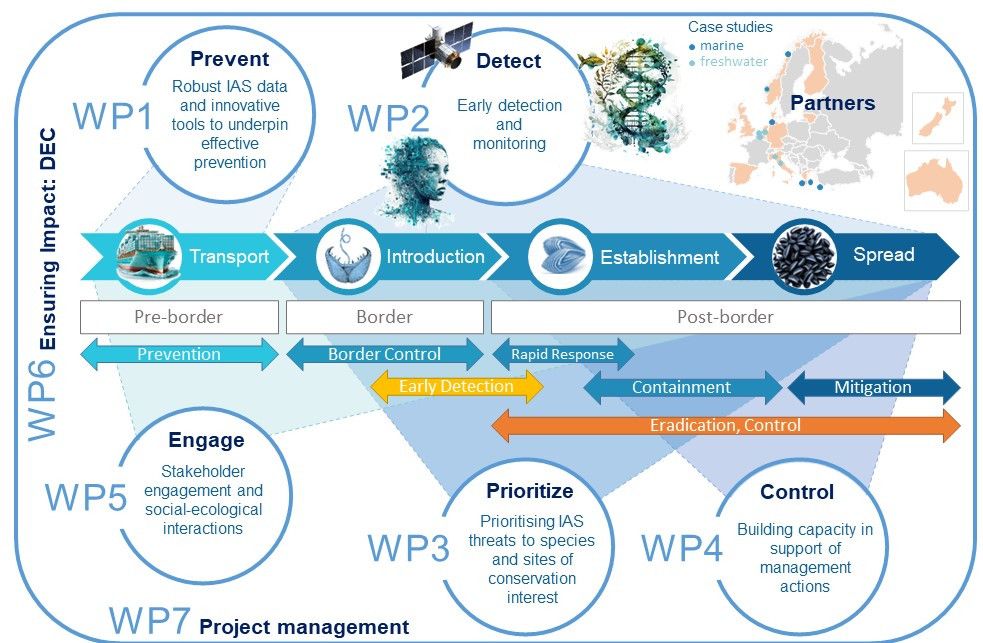
Since 2025, I have been actively involved in the Horizon Europe
GuardIAS project, a three-year
international initiative uniting 20 research institutions and EU agencies across 14 countries to
strengthen early detection and management of aquatic Invasive Alien Species (IAS) in Europe.
The project integrates artificial intelligence (AI), environmental DNA (eDNA),robotics, and early-warning
systems into coordinated, policy-relevant monitoring frameworks for marine and freshwater ecosystems.
Within GuardIAS, I co-lead a task focused on AI-enabled citizen science, leveraging the iNaturalist
platform and computer vision to improve the detection and monitoring of more than 250 priority aquatic IAS.
My work targets three key objectives: improving AI recognition accuracy for invasive taxa, reinforcing expert
validation workflows, and translating citizen-generated observations into operational early-detection and
monitoring pipelines. This approach substantially expands the spatial and temporal coverage of IAS observations
beyond the limits of traditional monitoring programmes, while maintaining robust data quality standards.
My contributions are already feeding into peer-reviewed outputs. A first manuscript is currently under review
in Environmental Monitoring and Assessment, and a second paper in preparation evaluates how citizen science data
complement conventional databases (e.g. GBIF, AquaNIS), reduce spatial gaps, and improve IAS distribution modelling.
In parallel, I contribute to a systematic review assessing the impacts of IAS on vulnerable and endangered Red List
species, strengthening the ecological basis for IAS risk prioritisation.
I am also engaged in capacity building and knowledge transfer. I served as a lecturer at the 2025 EU summer school
in Spain on AI and citizen science for biodiversity and invasive species monitoring, and I am part of the organising
and pedagogical team for the 2026 GuardIAS summer school on eDNA-based IAS early detection, to be hosted at Nord
University (Norway).
Contributing to GuardIAS via iNaturalist
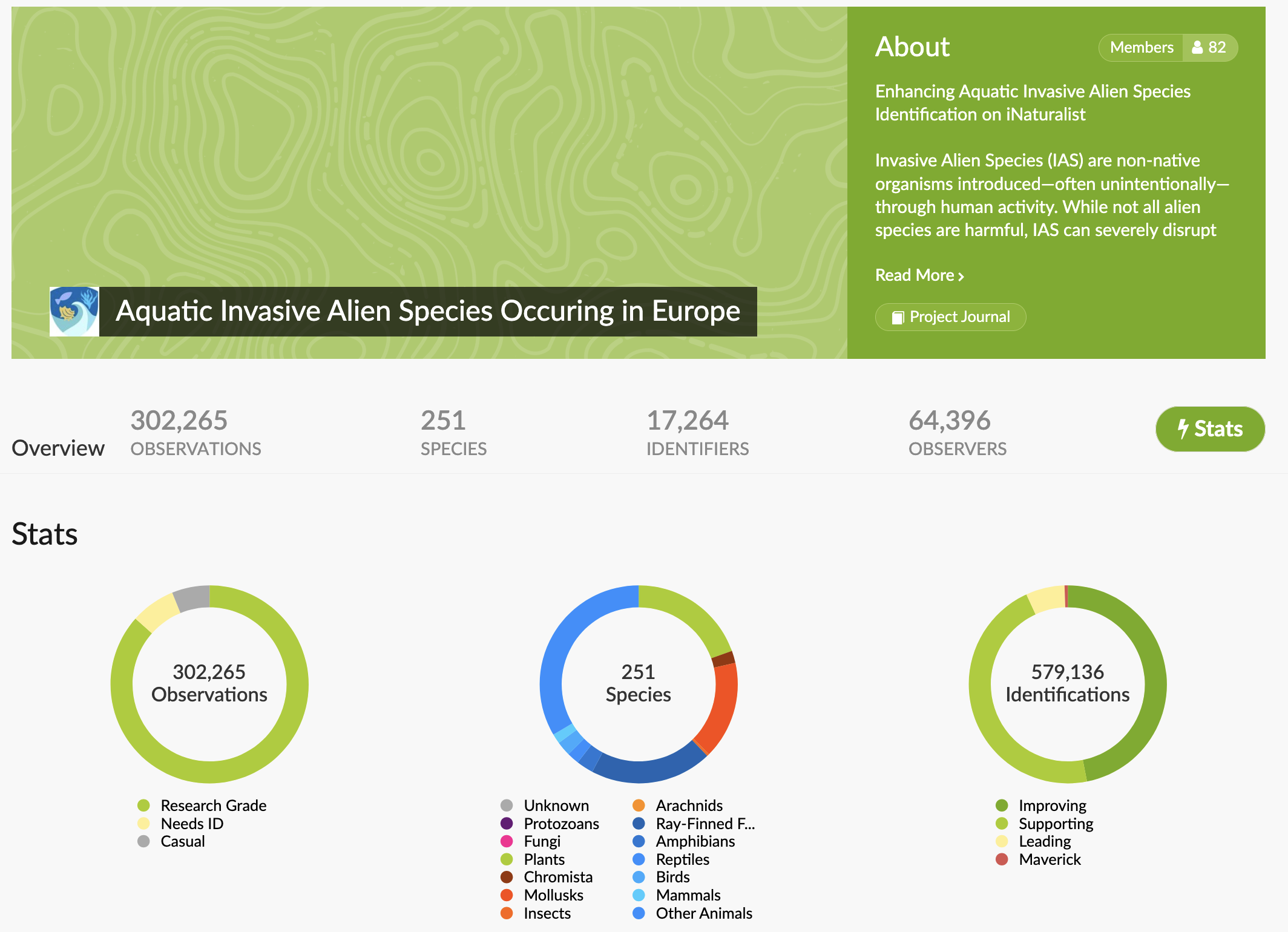
Citizen science is a key pillar of GuardIAS. I coordinate a dedicated initiative on iNaturalist—Aquatic Invasive Alien Species
Occurring in Europe—that invites naturalists, divers, environmental professionals, researchers, and interested citizens to contribute
directly to aquatic IAS early detection and monitoring across Europe.
By joining the project and submitting observations of aquatic IAS, contributors help improve AI-based species identification, strengthen
expert validation workflows, and expand the spatial and temporal coverage of IAS monitoring beyond what traditional surveys alone can achieve.
These contributions directly support the development of robust early-warning systems and evidence-based IAS management under GuardIAS.
To maximise scientific value, participants are encouraged to accurately georeference observations (ideally <1 km uncertainty), add biological
annotations when possible, upload historical records, and select open licenses that allow validated data to be integrated into international
biodiversity infrastructures such as GBIF.
Anyone can participate by uploading observations, assisting with species identification, or both. To join and contribute, visit the iNaturalist
project page: Aquatic Invasive Alien Species Occuring in Europe
Together, citizen observers, experts, and AI tools transform individual observations into operational data that strengthen IAS early detection
and support informed environmental decision-making across Europe.